
Grok 5 With 6 Trillion Parameters Set for Q1 2026: What Operators Actually Need to Know
**Executive Summary**
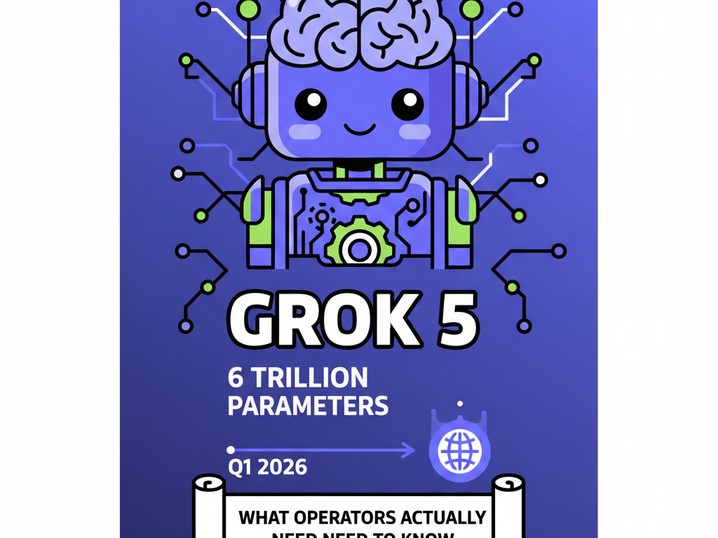
Elon Musk's xAI is shipping Grok 5 in Q1 2026 with 6 trillion parameters, real-time video processing, and continuous learning from live data streams.[1][5] Unlike static models, Grok 5 integrates directly into X and Tesla, giving it access to trending information as events unfold.[1] For lean teams building agent infrastructure or evaluating enterprise AI tooling, this forces a capability reset—but the real question isn't whether Grok 5 is powerful. It's whether the multimodal, real-time stack justifies pilot time and integration effort before deploying into production workflows.
---
The Scale Moment Nobody's Talking About
We've been watching the parameter wars for two years. Every few months, someone ships a model with more neurons and claims it's better. Most of the time, they're right—but only barely.
Grok 5 is different. Not because 6 trillion parameters alone is revolutionary. It's revolutionary because of what xAI is doing *with* them.[1][5]
Six trillion parameters is roughly **6x the density of most production models in 2025.** Think of parameters like the number of neurons in a brain. More neurons usually means more nuance, more memory, more ability to hold complex reasoning. But here's what makes this version sticky: **Grok 5 isn't just big. It's continuously fed real-time information from X and Tesla data streams.**[1][5]
That distinction matters for operators.
Every large language model shipped in the last three years has a training cutoff date. GPT-4 was trained through April 2023. Claude 3.5 through late 2024. These models are essentially frozen in time. Ask them about today's stock price, trending crisis, or viral viral hashtag? They admit they don't know.
**Grok 5 learns as events happen.**[1][5] Not through retraining—through continuous integration of live social and vehicle telemetry data. The team running the model gets younger information *in real time*.[1]
For most founders, that sounds like a feature. For teams managing customer support bots, research agents, or sales intelligence workflows, **it could be the difference between a tool that deflates two weeks after launch and one that scales for a year.**
---
What "Fully Multimodal" Actually Means for Your Workflows
The marketing usually says: *"Grok 5 processes text, images, audio, and video."*
That's technically true. But it misses the operational insight.
Most multimodal models today process one mode at a time. You upload an image, they analyze it. You paste text, they parse it. Speed matters, but rarely below 2-3 seconds per request. For a chatbot? Fine. For a real-time decision system? Sluggish.
Grok 5's pitch is different: **low-latency native multimodal understanding.**[1] Meaning your AI doesn't convert video to frames, images to vectors, and audio to spectrograms in separate passes. It processes all of them *together*, maintaining context across modes.[5]
Why does this matter?
Let's say you're running a customer service operation for a hardware startup. A support case comes in with a video of a product failure, a written description of the problem, and a photo of the error screen. Today, you'd:
- Pass the video to one model for visual analysis (30 seconds)
- Run the description through text AI (5 seconds)
- Have a human stitch together the picture (2 minutes)
With Grok 5's native multimodal pipeline, **a single model ingests all three, cross-references them, and flags the root cause in under 2 seconds.**[1][5]
Scale that across 200 tickets per day. That's 6 hours of human analysis time recovered per day.
**Pull-quote:** "Unlike most AI models frozen at a training date, Grok 5 learns continuously from live data streams on X and Tesla, making it responsive to real-time events as they unfold."[1][5]
---
The Operator's Real Question: Is the Hype Worth a Pilot?
We talk to founders every week who say: *"Our AI tool is fine. Should we even care about Grok 5?"*
Fair question. Here's the honest answer:
**If your current stack is working and ROI is proven, don't pilot Grok 5 just because it's new.** Switching costs are real: integration time, data pipeline changes, vendor risk, and retraining your team on a new interface.
**But if you're building agent infrastructure or evaluating enterprise AI in Q1 2026, you need to benchmark against it.**
Why? Because competitors will.
The teams who test Grok 5's reasoning capability, latency, and real-time accuracy in January will make faster infrastructure decisions than teams waiting until March. If Grok 5's real-time learning actually reduces hallucination in time-sensitive domains—sales leads, customer escalations, trend spotting—then the teams who find that first get a 6-month head start on competitor adoption.
We've also seen this pattern before: the model that looks "good enough" in benchmark comparisons often becomes the one that's best-in-class for specific operator workflows. Claude 3.5 wasn't the biggest, but it became the default for long-context analysis. GPT-4 Turbo wasn't the newest, but it held enterprise adoption longer than expected.
Scale (parameters) doesn't always mean speed or accuracy *in practice*. It depends on training data, infrastructure, and whether the improvement compounds in your specific use case.
---
Three Deployment Scenarios: Where Grok 5 Wins (and Where It Doesn't)
Scenario 1: Real-Time Analysis and Agent Orchestration
**This is where Grok 5 is built to dominate.**
If you're running sales intelligence, social listening, trend detection, or customer escalation routing, continuous learning from live data is a genuine edge.[1][5] The model doesn't need to wait for you to feed it new training data—it's already integrated into information feeds.
**Verdict: Pilot in January. High upside.**
---
Scenario 2: Long-Context Processing and Research
Grok 5 handles **128,000 tokens in a single session, meaning entire reports, transcripts, and long conversations without context loss.**[3] That's valuable for research teams, legal analysis, and policy review.
But here's the catch: Claude 3.5 and GPT-4 already handle 100,000+ tokens without losing coherence. The real question is whether Grok 5's extra capacity *plus* real-time data actually improves research quality for your use case—not whether it can technically do it.
**Verdict: Wait for early user case studies (February). Then evaluate.**
---
Scenario 3: Visual Content Analysis and Automation
Product teams, UX researchers, and designers could theoretically feed Grok 5 thousands of design mockups, user screenshots, and accessibility audits at once.[5] The multimodal processing happens natively, no pipeline stitching required.
The caveat: specialized visual models (like Claude's vision or GPT-4's image analysis) are already deeply tuned for specific visual tasks. Grok 5's generalist approach might be *good* without being *best* for narrow, high-accuracy visual work.
**Verdict: Test for speed and efficiency gains. Don't assume quality parity yet.**
---
The Integration Reality Check
Here's what vendor marketing won't tell you:
Deploying a new foundational model isn't just a model swap. You're also evaluating:
- **API latency and cost**: Is Grok 5's real-time processing cheaper than static models + external data enrichment?
- **Rate limits and reliability**: Can xAI's infrastructure handle production scale, or will you hit throttling?
- **Data custody**: How much of your proprietary data gets fed into Grok's live learning loop?
- **Vendor risk**: How dependent is your business on a single vendor (Elon, xAI)?
- **Integration lift**: How much engineering time to swap out your current model and retrain prompts?
For a 15-person team, that last one is critical. If your current LLM took 40 hours to integrate, Grok 5 will too—even if it performs 20% better.
---
The Competitive Forcing Function
OpenAI, Google, and Anthropic aren't asleep. But **Grok 5 arriving in Q1 2026 will force a capability reset at every company using static foundation models.**[1]
The teams that move first get three advantages:
- **First visibility into real-time multimodal performance at scale**
- **A clear benchmark for agent reasoning and latency**
- **Operator war stories** (which usually guide the next six months of industry adoption)
If you're managing an AI budget in Q1 2026, that's worth a pilot budget. Not because Grok 5 is definitely better. Because you won't know until you measure it.
---
The Bottom Line: Your Operator Checklist
**In January 2026, here's what we recommend:**
- [ ] **If you're shipping agent infrastructure**: Request early access to Grok 5's API. Benchmark latency, multimodal accuracy, and real-time reasoning against your current stack.
- [ ] **If you're evaluating enterprise AI tools**: Add Grok 5 to your RFP. Compare real-time accuracy, context handling, and integration cost against OpenAI's latest tier and Claude's current offering.
- [ ] **If your current LLM is solid and ROI is proven**: Monitor early operator case studies (not vendor press releases). Pilot only if you see a specific use case where Grok 5's real-time learning delivers measurable ROI.
- [ ] **If you're a solo founder or running a lean team**: Watch for the first wave of community benchmarks. Don't be early to a new vendor unless it's clearly 3x better. Usually it's 1.3x better with 2x the integration risk.
**The hardest part of AI adoption isn't the technology. It's deciding when to move.** Grok 5's timing—real-time data, native multimodal, enterprise scale—creates legitimate options for lean teams that didn't exist six months ago.
The question isn't whether to switch immediately. It's whether to pilot now and decide in March, or wait for operator case studies and decide in April.
For most operators running tight schedules, **pilot now. Decide later.**
---
**Meta Description:** Grok 5's 6T parameters and real-time learning arrive Q1 2026. For operators, the real question isn't raw power—it's whether multimodal integration and live data justify pilot time. Here's what actually matters.