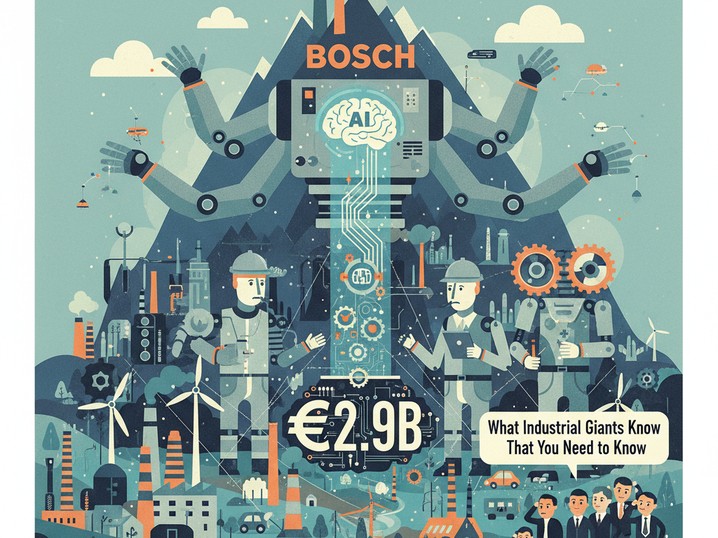

Bosch's €2.9B AI Bet: What Industrial Giants Know That You Need to Know
**Executive Summary**
- A $2.9 billion commitment through 2027 signals that edge AI and predictive manufacturing are moving from "nice-to-have" to essential infrastructure across supply chains.[1][2]
- Bosch's focus isn't on flashy consumer features—it's on quality detection, maintenance forecasting, and supply chain adaptability: the unglamorous work that saves 5-15% in operational waste.[3]
- For operators in manufacturing, logistics, and industrial services: expect vendor pressure to upgrade systems this year, and clearer ROI frameworks from software providers targeting production environments.
---
The Signal Nobody's Talking About (But Should Be)
Last week, Bosch—one of the world's largest automotive and industrial suppliers, operating in 60+ countries with 421,000 employees—announced it would invest more than $2.7 billion in artificial intelligence by the end of 2027.[4] This wasn't a press release buried in a tech blog. It was a statement, deliberate and public, that industrial AI has moved from pilot phase into core operations.
We've been watching this shift quietly in our own conversations with ops leaders. The companies winning are the ones who stopped asking "should we use AI?" and started asking "which processes do we automate first?"
Bosch's bet tells us something deeper: a global industrial heavyweight isn't hedging anymore. It's doubling down on edge-based systems, real-time quality control, and predictive maintenance as non-negotiable competitive infrastructure.
For operators running lean teams, that matters because it's about to change your vendor expectations, your hiring conversations, and your customer demands.
---
What Bosch Is Actually Building (And Why It Matters)
The €2.9 billion [1] isn't going into chatbots or content generation. Bosch is investing in three specific areas that reveal where industrial AI is heading:
**Manufacturing Quality & Defect Detection** Factories generate more data than they can act on. Cameras watch production lines. Sensors track machines. But most companies are still catching defects *after* products are finished.[3]
Bosch is deploying AI to camera feeds and sensor data to flag quality issues *while items are still on the line*. Instead of scrapping finished goods, workers get real-time alerts to adjust operations before waste compounds. For high-volume manufacturing, this isn't incremental—it's the difference between 2% scrap rates and 0.5%.[3]
Translation for you: If you're a vendor selling into manufacturing, this is your customer's new baseline expectation.
**Supply Chain Forecasting & Adaptability** The pandemic exposed how brittle supply chains are. Disruptions didn't disappear—they shifted.[3] Bosch is using AI systems to forecast demand, track parts across sites, and adjust plans when conditions change.
Even small improvements in planning accuracy compound across hundreds of factories and suppliers. Fewer emergency shipments. Less dead stock. Lower carrying costs. That's what Bosch is chasing, and it's what their customers will demand from them in return.
**Edge-Based Perception Systems** Bosch is building hardware and software that lets machines understand their surroundings in real time: cameras, radar, sensors feeding into AI models that recognize objects, judge distance, and spot anomalies.[3]
This is the unglamorous backbone of autonomous trucks, collaborative robots, and smart factories. It's not one headline feature—it's infrastructure. And infrastructure is what scales.
---
The Partnerships That Signal Direction
Bosch isn't building this alone. The company signed a memorandum of understanding with Microsoft to explore "agentic artificial intelligence" for factory optimization.[1] Translation: AI systems that interpret large datasets, make autonomous decisions, and execute tasks without constant human intervention.
Separately, Bosch partnered with Kodiak AI to collaborate on platforms for driverless trucks, supplying hardware components like sensors and steering technologies.[1]
What you're seeing here isn't diversification. It's ecosystem strategy. Bosch is betting that edge inference, real-time perception, and autonomous decision-making become standard infrastructure across mobility and manufacturing by 2030. They're investing to own multiple layers of that stack.
---
What This Means for Operators Running Lean Teams
**You're about to feel vendor pressure.**
When a $90+ billion company signals that AI is core infrastructure, suppliers, customers, and competitors notice. Expect your vendors to push for upgrades. Expect your customers to start asking why you're not using "advanced quality systems." Expect new competitors who've already started moving to show up with better efficiency metrics.
This year, the question shifts from "can we afford to invest in AI?" to "can we afford *not* to?"
**The ROI math is becoming real.**
We've guided teams through dozens of AI pilots. Most fail because they're vague. "Let's use AI to improve operations" never works. But "use computer vision to catch defects on line 3 before they cost $200 in rework" works every time.
Bosch's focus on quality, maintenance, and supply chain isn't accidental. Those are areas where the ROI is *already* clear to CFOs because the cost of failure is measurable and large.
When you're evaluating AI for your operation, ask:
- What's the cost of the problem we're solving? (Monthly, annual?)
- How will we know if it worked? (Defect rate down X%? Downtime reduced Y hours?)
- What's the pilot budget and timeline? (3 months, not open-ended.)
**Edge systems are becoming table stakes in manufacturing and logistics.**
The future isn't cloud-only AI. It's inference happening on-device, on-factory floor, on the truck—where latency and privacy matter. Bosch is investing heavily in perception systems that work at the edge because cloud-dependent systems fail when networks go down or latency matters.
If you're in manufacturing, supply chain, or logistics, expect this to show up in your RFPs in Q2-Q3 2026.
---
The Uncomfortable Truth: AI Alone Doesn't Solve This
We need to be honest. Bosch announced 13,000 job cuts by 2030 alongside this AI investment.[1] The company is automating work while investing in AI. That's not a contradiction—it's the reality of industrial transformation.
AI augments work that humans can't scale, and it automates work that's genuinely repetitive. But the transition period is messy. If you're an operator, you need to know this because:
- **Retraining costs are real.** If you're deploying predictive maintenance AI, someone needs to learn to act on those predictions differently. That's 40-80 hours of training per person.
- **Integration friction is underestimated.** Getting AI systems to talk to legacy manufacturing systems (PLCs, SCADA, ERP) takes engineering time. Budget 30-40% of your AI implementation time for plumbing.
- **Edge hardware isn't free.** Running inference on-device requires compute. Bosch is investing in hardware—cameras, sensors, specialized computers. This isn't just software.
---
Your Operator Playbook: What to Do Now
**If you're in manufacturing or logistics:**
- Audit your top three operational pain points. Which one has measurable costs? (Scrap rates, downtime, inventory carrying costs?) Start there, not everywhere.
- Request a pilot budget from leadership. Three-month tests, specific metrics, clear success/failure criteria. Avoid open-ended AI spending.
- Talk to your vendors about edge-based solutions. Cloud-only is convenient but fragile. Edge is more resilient.
**If you're selling into manufacturing:**
- Start positioning your offerings around specific outcomes: "Reduce defect detection time from 24 hours to real-time" lands harder than "we use AI."
- Prepare for integration conversations. Your customers will ask how your system talks to their ERP, MES, or SCADA. Have an answer.
- Build credibility with production data. Case studies showing actual scrap reduction or downtime improvement matter more than demo footage.
**If you're building AI infrastructure:**
- The market signal is clear: edge inference, real-time perception, and predictive systems are graduating from research to operations.
- Manufacturing and supply chain companies are moving faster than consumers realized. Don't compete on "most advanced"—compete on "most reliable at scale."
- The margin is in implementation and integration, not just models.
---
The Bottom Line
Bosch's €2.9 billion commitment isn't hype. It's a statement that AI for manufacturing, supply chain, and edge systems has matured from experiment to essential infrastructure.
For operators, this means: the next 18 months will define competitive advantage for the next five years. Companies that move now with clear ROI frameworks and realistic integration expectations will pull ahead. Companies that wait will spend the next three years catching up while paying more for the same outcome.
The window is open. What are you going to do first?
---
**Meta Description** Bosch's €2.9B industrial AI investment signals edge systems and predictive manufacturing are now essential. What operators need to know about vendor pressure, ROI frameworks, and moving fast in 2026.