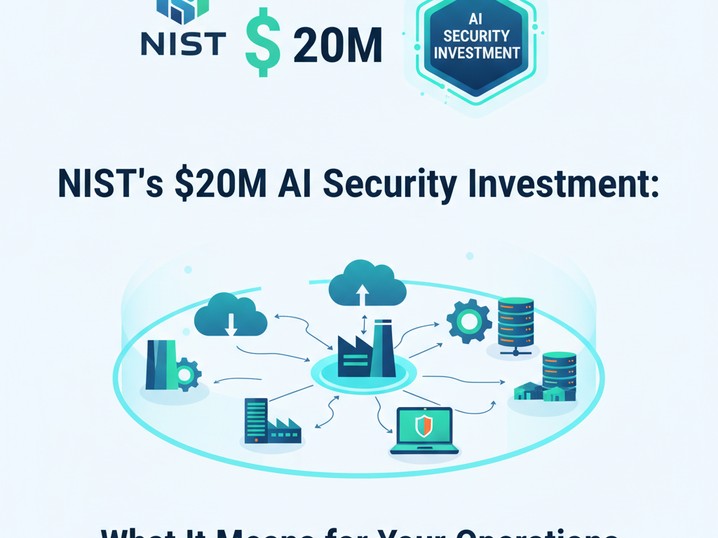

NIST's $20M AI Security Investment: What It Means for Your Operations
**Executive Summary**
- The U.S. government is now actively shaping how AI agents are built, tested, and secured in manufacturing and critical infrastructure—signaling that federal standards are coming.[1][5]
- If your company operates AI in these sectors, expect NIST guidance within months that could affect your roadmap, compliance burden, and vendor selection.[1][2]
- Early alignment with emerging standards gives you a competitive edge and reduces the risk of costly retroactive compliance work.
---
The Real Signal Behind the Headline
We've all gotten used to AI announcements that sound big and land quietly. But last December, the National Institute of Standards and Technology (NIST) announced something different: a **$20 million investment in two new AI Economic Security Centers**, operating in partnership with the nonprofit MITRE Corporation.[1][5]
On the surface, it's a funding move. Below the surface, it's a federal bet that the way we build and deploy AI agents in manufacturing and critical infrastructure needs to change—now.
Here's what we're actually looking at: NIST is moving from *advisory* (publishing frameworks) to *operational* (running centers that evaluate, test, and advance secure AI systems).[1][5] That distinction matters. When the government stops advising and starts operating, operators like us start paying attention—because guidance eventually becomes requirement.
If you run teams deploying AI in manufacturing, supply chain, energy, water systems, or communications, this shift isn't theoretical. It's a heads-up that your deployment playbook may need revision sooner than you thought.
---
What NIST Is Actually Building
The two centers have specific names and specific missions:
**The AI Economic Security Center for U.S. Manufacturing Productivity** will focus on applying AI to improve efficiency, quality, and competitiveness across U.S. industrial sectors.[1] Think: AI agents managing production lines, optimizing supply chains, automating quality control.
**The AI Economic Security Center to Secure U.S. Critical Infrastructure from Cyberthreats** will address the harder problem—real-time threat detection, predictive analytics, and automated response for systems that keep the lights on.[1] Think: AI monitoring power grids, water systems, communications networks for adversarial threats.
Both centers will be run by MITRE, which already operates the National Cybersecurity FFRDC (Federally Funded Research and Development Center).[1] Translation: this isn't a think tank or advisory group. It's a working lab with existing relationships to federal agencies, defense contractors, and critical infrastructure operators.
The centers will develop technology evaluations and advancements necessary to protect U.S. AI dominance while reducing risks from insecure or adversarial AI tools.[1] That's the mandate. What it means in practice: if you're deploying AI agents in these sectors, NIST-developed standards and evaluation frameworks are coming—and soon.
---
Why This Matters More Than Other Federal AI Initiatives
We've seen federal AI frameworks before. NIST itself published the AI Risk Management Framework in 2023, and it's been useful but not transformative. This is different for three reasons:
**First, it's operational, not aspirational.** NIST isn't writing guidelines from a conference room—they're running working centers that test actual AI systems in real-world conditions.[5] That means the standards emerging from these centers will be grounded in what actually works, not what sounds good in policy papers.
**Second, it's focused on deployment, not development.** The centers will develop and adopt AI-driven "agents"—autonomous tools that make decisions with minimal human intervention.[1] That's the deployment model that worries operators and regulators alike. You can test an AI chatbot in isolation. Testing an autonomous agent that's managing your manufacturing line or monitoring your grid is harder—and that's exactly what NIST is building infrastructure to do.
**Third, it's tied to national security and economic strategy.** This isn't a nice-to-have initiative buried in an agency budget. It's part of NIST's Strategy for American Technology Leadership in the 21st Century and explicitly aligned with the White House's AI Action Plan.[1][2] That means:
- Congressional backing
- Multi-year funding (NIST is planning up to $70 million over five years for manufacturing alone)[1]
- Coordination with other federal agencies
- Vendor participation (MITRE works with industry partners)[1]
When federal strategy aligns with enforcement capacity, standards move from optional to inevitable.
---
The Operator Reality: What Happens Next
Here's where this gets practical. If you're running AI in manufacturing or critical infrastructure, you're about to see three things happen:
**Guidance will emerge faster.** NIST's centers will publish evaluation methodologies, testing frameworks, and best practices starting within months.[2] Some will be voluntary; others will inform regulatory guidance from CISA, the Department of Energy, or the FAA. You'll want to read them as they drop—not after they become compliance requirements.
**Vendors will start positioning around NIST-compliance.** Your AI tool provider will eventually claim alignment with NIST frameworks. Verify that claim before you believe it. We've seen this before with SOC2 and ISO certifications—vendors slap logos on their site without meaningful validation. Ask for documentation. Ask for test results. Ask for third-party assessment.
**Your compliance timeline will compress.** If you've deployed AI agents without formal risk assessment or security evaluation, you now have a runway to formalize that work before federal standards harden. The companies that move first avoid the panic of compliance-by-deadline later.
---
How to Prepare: The Operator Playbook
You don't need to wait for NIST publications to get ahead. Here's what to do now:
**1. Audit your current AI deployments.** If you're using AI agents (not just ChatGPT, but autonomous systems making decisions), document:
- What decisions is the AI making?
- Who's responsible when it fails?
- How do you validate its output before it affects customers or operations?
- What happens if the system is compromised or fed adversarial inputs?
**2. Start with NIST's existing frameworks.** The AI Risk Management Framework is free and well-structured. Run your deployments through it now. It won't be wasted effort—the new centers will build on this work, not replace it.
**3. Engage with your vendors early.** Ask your AI tool providers:
- What security testing have they done?
- How do they validate model behavior in your specific use case?
- Do they have a roadmap for NIST-alignment?
- What happens to your deployment if they need to patch a security vulnerability?
**4. Join the conversation (selectively).** NIST runs public comment periods and stakeholder forums. If you operate AI in manufacturing or critical infrastructure, participating in early feedback shapes the standards that will eventually affect you. It's also where you learn what your peers are doing—valuable competitive intel.
**5. Budget for compliance work.** The companies that get this right early will invest in governance, documentation, and testing infrastructure now. That's not glamorous work, but it's cheaper than retrofitting security after deployment.
---
The Uncomfortable Truth
We get asked a lot: "Should I be worried about federal AI regulation?"
The honest answer: not yet, but the infrastructure for it is being built. NIST's investment in these centers is the physical manifestation of that shift. It's the government saying: "We're not going to outsource AI safety to market forces alone, especially in sectors that matter."
If you operate AI in manufacturing or critical infrastructure, that's you. The question isn't whether standards are coming—they are. The question is whether you'll shape them or scramble to meet them.
---
What to Do This Week
- **If you deploy AI agents:** Document one system completely. What does it do? Who owns it? How is it validated?
- **If you're evaluating AI tools:** Ask vendors about NIST frameworks. Not "Are you NIST-compliant?" (too vague). Ask "How do you address the risk categories in NIST's AI Risk Management Framework?"
- **If you're in manufacturing or critical infrastructure:** Set a calendar reminder to review NIST announcements in Q1 2026. The centers are just launching. Guidance documents will start appearing within weeks.
- **If you're unsure whether this applies to you:** Ask: Does my AI system make autonomous decisions that affect operations, safety, or customer outcomes? If yes, you're in scope.
---
The Bottom Line
Federal AI governance is moving from advisory to operational. NIST's $20 million investment signals that agencies will now test, evaluate, and publish standards for secure AI agents—particularly in sectors that touch infrastructure and manufacturing.
You don't need to panic. You do need to pay attention. The operators who align early won't be scrambling for compliance later.
---
**Meta Description:** NIST invests $20M in AI security centers for manufacturing and critical infrastructure. Here's what that means for your deployment timeline and compliance roadmap.