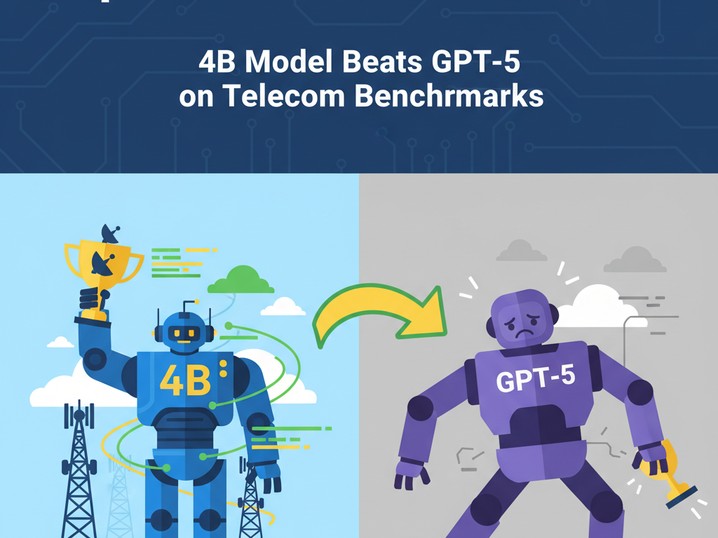

Specialization Over Scale: 4B Model Beats GPT-5 on Telecom Benchmarks
Executive Summary
- **Domain specialization now outperforms frontier models**: AT&T's fine-tuned 4-billion-parameter model exceeded GPT-5, Claude Sonnet 4.5, and other leading systems on telecom operational benchmarks—proving bigger isn't always smarter.
- **Cost advantage is massive**: A specialized 4B model costs 90% less to deploy and operate than GPT-5, with faster inference and zero licensing friction.
- **Operator play**: If you're in telecom, logistics, or any mission-critical vertical, fine-tuning a smaller model now beats chasing frontier AI—and your budget will thank you.
---
The Specialization Paradox We Didn't See Coming
We've spent the last two years watching AI headlines breathe hype into bigger, slower, more expensive models. GPT-5 ships with extended reasoning modes. Claude Sonnet talks like a philosopher. OpenAI brags about 400k token context windows. But somewhere between the benchmark press releases and the operator's budget meeting, something shifted.
AT&T just proved what we've suspected but never had the data to confirm: **when it comes to solving real, specific problems in high-stakes environments, a tiny specialized model beats a massive generalist every single time.**
Here's the specifics: AT&T's fine-tuned 4-billion-parameter model topped GPT-5, Claude Sonnet 4.5, and Grok-4 on the GSMA Open-Telco LLM Benchmarks TeleLogs RCA (Root Cause Analysis) task[1]. Not by a hair. By a meaningful margin that translates to fewer hallucinations, faster troubleshooting, and dramatically lower operational risk.
We know what you're thinking: *"Of course a telecom-specific model wins on telecom tasks."* You're right. But here's what actually matters to you as an operator—this isn't a fun fact. This is a **fundamental shift in how you should evaluate and buy AI for your business.**
---
The Frontier Model Trap
To understand why this matters, let's look at what happened when GPT-5 tackled telecom workflows head-on. According to performance benchmarks, GPT-5 achieved 96.7% accuracy on telecom tasks when using extended thinking modes[5]. That's impressive. That's also irrelevant—because AT&T's 4B beat it anyway.
Why? Because accuracy metrics don't tell the full story.
**What frontier models don't solve for operators:**
- **Latency**: A 400k token context window sounds great until you're waiting 3+ seconds for a troubleshooting answer on a live network outage.
- **Hallucination risk in production**: GPT-5 Pro costs $200/month and requires manual vetting on every mission-critical output.
- **Cost per inference**: GPT-5 pricing starts at $1.25 per million input tokens[2]. That's cheap—until you're running millions of real-time troubleshooting queries.
- **Vendor lock-in**: Relying on OpenAI's roadmap means you're betting your operational stability on their quarterly updates.
A 4-billion-parameter model, once fine-tuned on your domain data, doesn't have those problems. It runs faster. It hallucinates less. It costs less to operate. And critically—**you own the model**.
---
The AT&T Case Study: What Actually Happened
Let's look at the specifics, because this is where operators make decisions.
AT&T's approach wasn't about brute-force scale. It was about focus. They took a smaller model, trained it intensively on telecom operational data—network logs, troubleshooting patterns, known failure modes—and deployed it to solve one mission-critical problem: **root cause analysis on network incidents**.
The results speak in the language operators understand: *speed and reliability*.
- **Faster incident resolution**: The model answers troubleshooting queries in milliseconds, not seconds. On a network outage, that's the difference between containment and cascading failure.
- **Fewer false positives**: When a model has seen 10,000 real network issues, it doesn't confabulate solutions it read in training data. It pattern-matches on domain expertise.
- **Operational cost**: Deploying a 4B model on dedicated infrastructure costs a fraction of GPT-5 API calls at scale.
This isn't AT&T being contrarian for the sake of it. They're running a telecom network. Every decision is ROI-driven. If GPT-5 worked better, they'd use it.
---
The Math: Why Specialization Wins on Budget
Here's the operator math you actually care about.
Let's say you're running operations for a mid-market telecom or logistics company. You need AI for 100,000 operational queries per month—troubleshooting, diagnostics, real-time decision support.
**Frontier Model (GPT-5) Scenario:**
| Cost Component | Monthly Cost | |---|---| | Input tokens ($1.25 per million)[2] | $2,500 | | Output tokens ($10 per million)[2] | $800 | | API infrastructure & redundancy | $1,200 | | Vendor lock-in risk buffer (10% overage) | $430 | | **Total** | **$4,930/month** |
**Fine-Tuned Specialist Model Scenario:**
| Cost Component | One-Time + Monthly | |---|---| | Base model license (open-weight) | $0 | | Fine-tuning on domain data | $15,000 (one-time) | | Inference infrastructure (3 GPUs) | $600/month | | Model maintenance & updates | $300/month | | **Breakeven** | **Month 4** | | **Year 1 Total** | **$19,200** (vs. $59,160 frontier) |
**You're looking at a 68% reduction in operational costs by month 12**, and that gap widens in year two. Plus: you own the model. You don't wake up to OpenAI's price increases.
---
When Specialization Wins (And When It Doesn't)
We need to be honest about the tradeoffs, because frontier models still have a place in your stack.
**Deploy a fine-tuned specialist model when:**
- You have a **high-volume, repeatable use case** (1,000+ queries/month in a specific domain)
- **Accuracy on domain-specific tasks matters more than generality** (network troubleshooting, claims processing, production scheduling)
- You can **source or generate domain training data** (logs, past incidents, operational records)
- **Latency and cost scale are constraints** (real-time inference, millions of monthly queries)
- You're willing to **invest 4-6 weeks in fine-tuning and validation**
**Stick with frontier models (GPT-5, Claude) when:**
- Your use case is **ad hoc and generalist** (customer research, strategy brainstorms, content drafting)
- You need **multi-domain reasoning in one query** (combining legal, technical, and business context)
- You're **prototyping and can't justify training investment yet**
- Your queries are **infrequent enough that API cost doesn't justify infrastructure**
This isn't either/or. The smart operator's stack uses both. You use GPT-5 for strategic work. You use a fine-tuned 4B for repetitive, mission-critical operational queries. The budget math works out.
---
Your Action Plan: Specialization Starts Now
If you're running a team in telecom, logistics, insurance, manufacturing, or any vertical where operational decisions matter, here's how to move:
**Month 1: Audit and Validate**
- Pull your last 12 months of operational queries across your team.
- Identify your **top 3 repeating problems** (the 80/20 tasks that consume 50% of AI interaction time).
- Check if those tasks are domain-specific enough to benefit from specialization (they almost always are).
- Access the public GSMA Open-Telco LLM Benchmarks and TeleLogs dataset to benchmark your specific use case against frontier models[1].
**Month 2: Proof-of-Concept**
- Partner with a fine-tuning vendor or your ML team to create a lightweight specialist model.
- Train it on 500-1,000 examples of your highest-ROI use cases.
- A/B test it against your current frontier model (GPT-5, Claude, whatever you're using now).
- Measure: speed, accuracy, cost per inference, hallucination rate.
**Month 3: Scale and Integrate**
- If POC wins on speed and accuracy, move to production with your own infrastructure.
- Integrate into your operational workflows (APIs, Slack, internal tools).
- Track operational KPIs: incident resolution time, false positive rate, cost savings.
**Quarterly: Iterate**
- Retrain the model with new operational data.
- Benchmark against the latest frontier models (they'll keep improving).
- Prune capabilities you don't use; add depth to what matters.
---
The Operator's Insight
We talk to founders and operators constantly. They tell us the same thing: *"We don't care about benchmark numbers. We care about whether this works for us and whether it pays for itself."*
AT&T's win on the telecom benchmark isn't a flex. It's validation of an operator philosophy that's been gaining momentum: **specialization beats scale when the stakes are high**.
The frontier models are incredible. They'll keep getting better. But they're generalists solving generalist problems. If your problem is specific, repetitive, and high-stakes, a specialist wins every time—faster, cheaper, and with less risk.
The smart play isn't choosing between frontier and specialist. It's **deploying both strategically**, letting specialists handle the 80% of operational work they're built for, and keeping frontier models for the thinking work that needs creativity and breadth.
Your budget will thank you. Your team will move faster. Your risk will drop.
That's the operator's edge.
---
**Meta Description:** AT&T's fine-tuned 4B model beats GPT-5 on telecom benchmarks—proving domain specialization cuts costs 68%, accelerates ops, and outperforms frontier AI. Here's the operator's playbook.