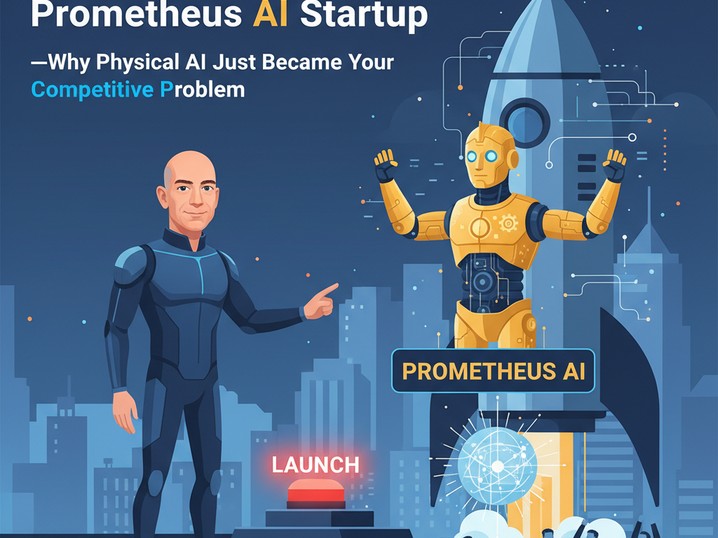

Bezos Launches Project Prometheus AI Startup—Why Physical AI Just Became Your Competitive Problem
**Executive Summary**
- Jeff Bezos is returning to an operational CEO role for the first time since 2021, co-leading a $6.2 billion AI startup focused on "physical AI"—AI systems that learn from real-world experimentation, not chatbots.[1]
- Project Prometheus isn't chasing LLMs; it's targeting manufacturing, logistics, robotics, and aerospace—industries where a competitive edge directly cuts costs and accelerates product cycles.[1][2]
- For operators running lean teams, this signals an escalating war for AI talent and capital that will reshape tool availability, pricing, and competitive dynamics faster than most realize.
---
Here's What Actually Happened (And Why It Matters More Than a Press Release)
I'll be direct: when billionaires leave billion-dollar empires to run startups, something structural is shifting.
Jeff Bezos stepped back into an operational leadership role this month as co-CEO of Project Prometheus, a new AI company that raised $6.2 billion before shipping a single product.[1] That's not typical. It's a signal. Bezos doesn't do press releases for incremental plays—he bets on category shifts.
This isn't another chatbot company. And it's not another venture fund betting on AI commoditization.
Project Prometheus is building what they're calling "physical AI"—artificial intelligence systems trained on real-world experimentation, designed to solve engineering, manufacturing, logistics, and robotics problems.[1] Think less "ChatGPT for your team" and more "AI that runs your factory floor, optimizes your supply chain, or designs the next generation of aerospace components."
For operators like you—founders and team leaders managing lean teams, watching every dollar, competing against better-capitalized companies—this announcement matters because it signals two things: (1) the AI frontier is moving past consumer-facing tools, and (2) major capital and talent are consolidating around industrial-scale problems where ROI is undeniable.
We've been in the hype cycle long enough to know the difference between noise and signal. This is signal.
---
Why Bezos Returning to the CEO Chair Changes the Game
The timing is what catches us. Bezos has spent the last four years as Blue Origin CEO and philanthropist, comfortable. He didn't need to run another startup. The fact that he did—and brought Vik Bajaj (a physicist who built moonshot projects at Google X, including early Waymo work) as co-CEO—tells us Bezos sees a gap in the market that only direct leadership could exploit.[2]
Here's what matters: Bezos has **operational DNA around logistics, hardware, and systems thinking** that most AI founders don't.[2] He spent decades building Amazon's warehouse networks, managing the physical infrastructure behind every purchase. He's currently running Blue Origin, a company that literally manufactures rockets. He invested early in Physical Intelligence, another robotics-AI startup.
This isn't random. Bezos is saying: "The next wave of AI wins aren't in software. They're in physical systems—and I know how to build those."
We've seen this pattern before. When experienced operators spot an unmet need and commit capital and their own time, competitive dynamics shift. Talent moves. Tool vendors adjust roadmaps. Funding flows. Smaller teams that didn't hedge get outpaced.
The question for you isn't whether Project Prometheus will succeed. The question is: **How does a $6.2 billion bet on industrial AI reshape what tools, talent, and competitive advantages are available to your team over the next 18 months?**
---
Physical AI: What It Actually Means (Beyond the Marketing)
Let's translate the jargon.
"Physical AI" means artificial intelligence trained on real-world experimentation—robots running trials, systems learning from actual manufacturing data, models that improve because they're connected to real engineering problems, not just text corpora.[1][2]
Compare that to the AI most of us have been using:
**LLMs (Large Language Models):** Trained on text, good at generating language, reasoning, and handling knowledge work. The ChatGPT paradigm.
**Physical AI:** Trained on real-world systems. Learns by doing. Optimizes manufacturing processes, supply chains, product design, autonomous systems. Delivers measurable ROI because it directly touches production, logistics, or engineering outcomes.
Here's why this distinction matters to operators:
LLM tools are getting commoditized fast. Prices are collapsing. Everyone has access to similar models. Differentiation is harder. ROI is vague ("We use AI for copywriting"—great, but how much time does that actually save?).
Physical AI is different. It's **harder to commoditize** because each implementation is tied to a specific business's operations, data, and constraints. ROI is unambiguous: "We cut manufacturing lead time by 15% and reduced defect rates by 8%." Those are numbers that actually move the needle.
Project Prometheus is hiring almost 100 people from OpenAI, DeepMind, and Meta—the research elite.[1][2] That talent isn't building another Slack bot. They're building AI systems that run factories.
For us as operators, this means: Watch where top AI talent actually goes in 2026. If the best researchers are consolidating around physical AI, that's where capital flows next. That's where enterprise AI adoption actually accelerates. That's where competitive advantage gets built.
---
What This Actually Means for Your Business (The Operator Lens)
Let's get practical. We're not running aerospace companies. Most of us are running 5-50 person teams trying to compete with bigger companies by working smarter.
**Here's where this matters:**
**1. Logistics and supply chain optimization** (if that's part of your business)
If you're managing inventory, delivery networks, or warehouse operations, even at a smaller scale, the gap between "manual process" and "AI-optimized logistics" is about to widen significantly.[2] Project Prometheus is explicitly focused on this. Larger competitors with better data access will integrate physical AI into their operations before smaller teams do. That's a competitive moat.
**Ask yourself:** How much of our operational cost is tied to logistics inefficiency? If the answer is "non-trivial," you need to watch this space. Not panic—watch.
**2. Product R&D and engineering cycles** (if you build products)
Physical AI can accelerate prototype testing, material science, simulation, and design validation.[2] Companies using AI to run thousands of simulations instead of hundreds of physical tests ship products faster. They iterate cheaper.
For smaller product teams, this might mean: your lead time to market could narrow compared to competitors who aren't using physical AI yet. But it also means you can't outrun better-capitalized teams forever if they adopt this stuff first.
**3. Manufacturing and quality control** (if you make things)
Real-world AI trained on your factory data can predict failures, optimize throughput, and reduce defects.[1] The ROI is measurable. It's not "feeling more productive"—it's "we reduced downtime by 10% and saved $200K last quarter."
---
The Talent War Is About to Get More Vicious
Here's the uncomfortable part: $6.2 billion in funding, deployed by Bezos and a Google X veteran, doesn't just build product. **It pulls talent.**
When a major CEO with credibility launches a new company, researchers and engineers move. They move because:
- Bezos has proven he can scale at global scale
- The problem space (physical AI for manufacturing, logistics, aerospace) is genuinely unsolved
- The funding means no compromise on tooling, compute, or hiring standards
What does this mean for operators? **Talent you want to hire just got more expensive and harder to find.** AI engineers will have more options. That's real friction in 2026.
For lean teams, this means: If AI expertise is core to your competitive advantage, you need to think now about how to attract and retain people while competing against billionaire-backed startups. That might sound bleak. It's not—but it's honest.
---
Your Three-Month Operator Checklist
We're not asking you to panic or overhaul your tech stack. We're asking you to think strategically.
**This quarter, do this:**
**1. Map your competitive exposure to physical AI**
- Does your business touch manufacturing, logistics, supply chain, or complex engineering?
- If yes, where? And what would a 10-15% efficiency gain mean to your margins?
- This isn't academic—it's a risk assessment.
**2. Watch the talent market**
- Track where AI researchers are moving in 2026.
- If the best talent consolidates around specific companies or sectors, that tells you where capability is moving.
- Adjust your hiring strategy accordingly (either double down early or focus on different skills).
**3. Start running small physical AI pilots**
- You don't need to wait for Project Prometheus products. Tools for robotics AI, logistics optimization, and manufacturing simulation already exist (Periodic Labs, Boston Dynamics, etc.).
- Pick one operational pain point and test whether physical AI actually moves the needle for you.
- Real data beats theory every time.
**4. Avoid the hype, but don't ignore the signal**
- This isn't a "we need to pivot immediately" moment.
- This is a "we need to understand our vulnerability and optionality" moment.
- Most teams will sleep on this for two years. If you move deliberately now, that's an edge.
---
The Real Takeaway
Major founder capital isn't usually wasted. When Bezos steps back into an operational role and raises $6.2 billion, it means he sees a gap that he can exploit faster and better than incumbents can respond to.
That gap is physical AI—AI systems that directly optimize real-world operations and deliver measurable ROI.
For operators running lean teams, this announcement signals three things:
- **Talent consolidation:** Top AI researchers are moving toward industrial-scale problems. That changes what's available to you.
- **Capital redeployment:** Funding that might have gone to your next round is pooling elsewhere. Understand where.
- **Competitive timing:** The window to move early on physical AI for your specific domain is open. In 18 months, it may not be.
You don't need to react immediately. But you do need to pay attention and map your specific exposure.
The best operators don't predict the future—they prepare for multiple futures and stay ready to move. This is the moment to start that prep work.
**Question for you:** Does your business have a logistics, manufacturing, or operations component where a 10-15% efficiency gain would materially change your margins? If yes, flag it. Test it. And stay skeptical but open. That's how lean teams compete against bigger capital.
---
**Meta Description:** Jeff Bezos launches Project Prometheus, a $6.2B AI startup focused on physical AI for manufacturing and logistics. Here's what it means for your competitive edge and team.