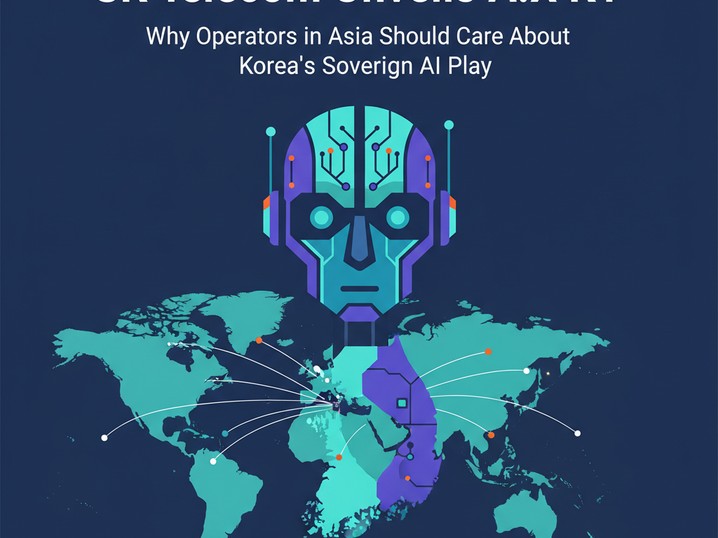

SK Telecom Unveils A.X K1: Why Operators in Asia Should Care About Korea's Sovereign AI Play
**Executive Summary**
- **The move:** SK Telecom released A.X K1, a 519-billion-parameter open-source model positioned as Korea's national AI infrastructure, with 20+ institutions already committed and open API access planned.[1]
- **What it changes:** For operators in Asia, this signals the first credible locally-governed alternative to US hyperscalers—with potential advantages in latency, data residency, and compliance costs.[1]
- **Your next step:** If you operate in or sell into Asia, start mapping how regional AI infrastructure plays affect your supplier lock-in and cost structure in the next 12 months.
---
The Play: Why a Telecom Giant Just Became an AI Infrastructure Company
We've watched this story play out before. A major incumbent in one industry (telecom, semiconductors, cloud) realizes the real moat isn't the old business—it's the infrastructure underneath everything else. SK Telecom just made that move explicit.
On December 27, SK Telecom announced A.X K1, a hyperscale AI foundation model with 519 billion parameters, developed by an eight-member consortium spanning SK hynix, SK Innovation, and dozens of other Korean institutions.[1] This isn't a chatbot competitor or a vertical AI tool. It's foundational infrastructure—the kind of thing nations build when they're serious about not depending on foreign suppliers for AI.
For operators, especially those running teams across Asia, this matters in ways that aren't obvious from the press release.
The usual tech headlines will focus on specs: "Korea's largest model," "open-source," "positioning Korea as top-three AI nation." But those are vanity metrics. What actually matters is *who controls the data, where the compute runs, and what it costs you to use it*.
The Strategic Context: Why Now, Why Korea
The US and China have established dominance in frontier AI. The EU built regulation to protect sovereignty. Now Korea—a country with deep semiconductor expertise, advanced infrastructure, and geopolitical reasons to want independence—is building its own foundation layer.[1]
We've seen this calculation before with other infrastructure plays. Countries invest heavily in foundational tech not because they expect immediate ROI, but because the alternative—being dependent on others for core utilities—becomes unacceptable over time.
For operators, here's what shifts: **when viable local alternatives exist, your negotiating position with US vendors changes**.
Today, if you operate a startup in Singapore, Seoul, or Tokyo, you have one realistic choice for frontier AI: OpenAI, Anthropic, or Google, all US-based. That means:
- Your data crosses international borders (compliance headaches)
- Latency is dictated by routing through US infrastructure
- Pricing is set on US vendor timelines
- If geopolitical friction escalates, access is unclear
A.X K1 doesn't solve all of that immediately. But it signals that the alternative might exist within 12-24 months.
What A.X K1 Actually Does (And Why the "Teacher Model" Angle Matters)
Here's the technical positioning: A.X K1 functions as a "Teacher Model"—it's designed to transfer knowledge to smaller, specialized models rather than be a direct end-user replacement.[1]
Translation: SK Telecom isn't trying to beat ChatGPT. They're building the foundational layer that lets Korean (and regional) companies build *their own* specialized AI products without starting from scratch.
This is a smarter play than head-to-head competition.
**Why this structure works operationally:**
- **Lower compute cost for deployment:** Smaller specialized models (below 70B parameters) cost less to run than a 500B foundation.[1] If you're building a customer service bot, fraud detection system, or document classification tool, you don't need the full 519B—you use a smaller model trained by A.X K1.
- **Data sovereignty without rebuild:** Korean companies can fine-tune smaller models using local data without retraining from scratch. That's where real competitive advantage lives in AI.
- **Ecosystem play, not winner-take-all:** By open-sourcing the approach and partnering with 20+ institutions, SK Telecom creates a tide that lifts many boats—rather than betting everything on A.X K1 itself winning the market.
Already, over 20 major institutions across semiconductors, gaming, research, and enterprise services have signed intent agreements to participate.[1] That's not hype—that's a coalition forming.
---
The Operator Reality: Latency, Compliance, and Total Cost of Ownership
Let's translate this into the actual decisions you're making.
**Current state (Q4 2025):** If you run a product or service in Asia and rely on frontier AI, you're using US-hosted APIs. You're paying per-token pricing set by OpenAI or Anthropic. Your data crosses borders. Compliance with local data residency rules requires workarounds.
**Emerging state (2026-2027):** A.X K1 and similar regional models may offer:
- **Lower latency:** Compute running in-region (Korea, Southeast Asia via local partners) beats roundtrip to US.
- **Data residency:** No cross-border data transfer if you're comfortable with Korean infrastructure governance.
- **Compliance simplicity:** Local hosting can satisfy stricter data localization rules in Singapore, Vietnam, and other jurisdictions.
- **Pricing flexibility:** When local alternatives exist, US vendors typically adjust terms downward.
The honest assessment: A.X K1 likely won't outperform frontier US models on raw capability *immediately*. But it will be "good enough" for many use cases—and "good enough with local hosting" often beats "best-in-class with 200ms latency and cross-border compliance friction."
---
When A.X K1 Becomes Your Problem (Or Opportunity)
We see operators typically react to infrastructure shifts in three patterns:
**Pattern 1: Early adopters in compliance-heavy industries** Regulated sectors (finance, healthcare, data processing) in countries with strict residency laws will pilot A.X K1 quickly. If your company operates in Singapore (PDPA), Thailand (PDPA-equivalent rules), or South Korea itself, compliance tailwind could justify a pilot in H1 2026.
**Pattern 2: Cost arbitrage players** If you're running high-volume AI inference (document processing, translation, customer support triage), a 20-30% cost reduction via regional hosting is material. Watch for pricing announcements in Q2 2026.
**Pattern 3: Vendor pressure** The moment credible regional alternatives exist, US vendors will see pressure to negotiate on pricing and terms. If you've been stuck negotiating with OpenAI's enterprise sales team, A.X K1's existence gives you leverage within 6-12 months.
---
What You Need to Know Right Now (And What to Ignore)
**Track these signals in the next quarter:**
- **Pricing announcement:** When SK Telecom releases API pricing for A.X K1 (expected Q1 2026), compare directly to OpenAI/Anthropic on $/1M tokens for similar workloads. That's your real decision data.
- **Regional deployment roadmap:** Where are the first commercial instances running? Korea only, or expanding to Singapore, Japan, India? Geographic availability determines relevance to your ops.
- **Consortium expansion:** Are more major companies joining the initiative, or has momentum stalled? Coalition health predicts likelihood of sustainable alternative.
- **Specialized model outputs:** The real proof is whether Korean companies release usable fine-tuned models (e.g., domain-specific customer service bots, compliance tools). That's when you know the infrastructure works operationally.
**What to ignore for now:**
- Capability comparisons to GPT-4 or Claude. Those don't matter if A.X K1 solves your actual problem 80% as well for 40% less.
- Geopolitical rhetoric. Focus on technical capability and reliability, not nationalist framing.
- Feature parity promises. SK Telecom will make expansive claims. Wait for independent third-party benchmarks.
---
The Pilot Framework: Should Your Team Explore A.X K1?
**Deploy this quarter if:**
- You're processing sensitive data in Asia and facing residency compliance friction.
- Your current OpenAI costs exceed $5K/month and you're running inference-heavy, not reasoning-heavy workloads.
- You operate in a jurisdiction (South Korea, Singapore, Vietnam) where local suppliers are preferred for government/enterprise contracts.
**Pilot in Q1 2026 if:**
- You're currently evaluating AI vendor options and want to avoid lock-in.
- You have the technical bandwidth to run a 30-day parallel test (same workload on A.X K1 vs. current vendor).
- Cost reduction of 25%+ would materially improve unit economics.
**Skip for now if:**
- You need frontier reasoning capability (complex reasoning, novel problem-solving). A.X K1 is strong on multilingual and mathematical tasks, but not proven on AGI-forward benchmarks yet.[1]
- Your team lacks DevOps expertise to manage open-source model deployment.
- Regulatory requirements explicitly mandate US-based hosting (rare, but it happens in certain sectors).
---
The Real Implication: Infrastructure Pluralism Is Coming
Here's what matters strategically: we're moving out of the era where one or two US vendors control the entire AI stack. A.X K1 is one signal. Similar initiatives are underway in Europe, UAE, India, and Japan.
That fragmentation is uncomfortable for vendors who've built moats on centralized control. For operators, it's a gift.
**The practical upside:** More choices → lower prices, better terms, and less geographic lock-in. The moment your vendor knows you have a credible alternative in your region, negotiating power shifts.
We've guided teams through this before with cloud infrastructure (AWS → Azure/GCP competition) and open-source databases (Oracle → PostgreSQL). The pattern is consistent: infrastructure pluralism always favors operators over vendors long-term.
---
Your Action Plan
**This week:**
- If you're running AI workloads in Asia, add "regional AI infrastructure alternatives" to your Q1 2026 supplier review.
**Next month:**
- Request a pricing forecast from SK Telecom or their regional partners. Actual numbers > marketing claims.
- Benchmark your current AI spend and identify which workloads would benefit from lower latency or local hosting.
**By March 2026:**
- Run a 2-week pilot on one non-critical workload (customer support classification, document routing, basic summarization). Compare cost, latency, and output quality vs. your current vendor.
**Watch for:**
- First enterprise customers deploying A.X K1 in production. Their case studies will teach you more than any press release.
- Integration partnerships with tools you already use (Retool, n8n, Zapier, CRM platforms). That's when A.X K1 moves from infrastructure play to practical optionality.
---
The Bottom Line
SK Telecom's A.X K1 isn't a ChatGPT competitor and it doesn't need to be. It's the first credible signal that frontier AI infrastructure might not be permanently owned by US vendors. For operators in Asia, that changes the calculus on vendor lock-in, compliance friction, and long-term cost trajectory.
The smart move isn't to switch immediately. It's to treat A.X K1 as an emerging option—something worth piloting in H1 2026 once pricing and regional availability are concrete. Use its existence as leverage with your current vendors. Prepare your team for a multi-vendor AI future.
That future isn't here yet. But it's coming. And the teams that move first get the best terms.
---
**Meta Description** Korea's first 500B-parameter AI model offers Asia-based operators a locally-governed alternative to US hyperscalers—here's when and why to pilot it, plus the compliance and cost implications.