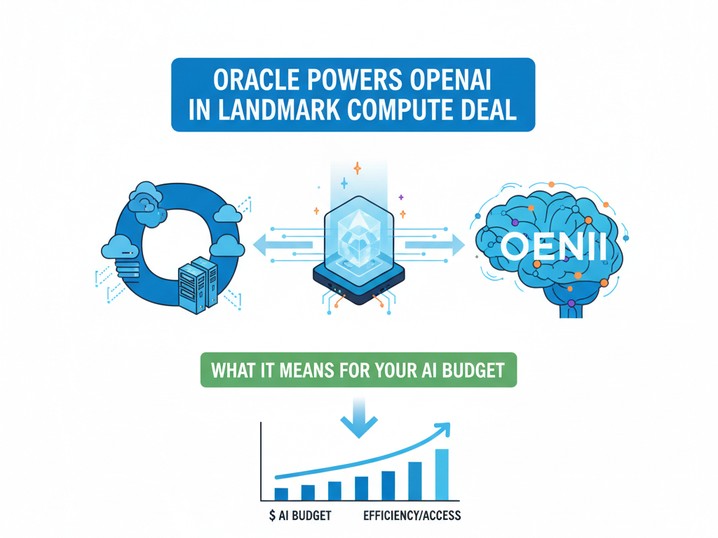

Oracle Powers OpenAI in Landmark Compute Deal: What It Means for Your AI Budget
**Executive Summary**
- OpenAI locked in $300 billion of compute power from Oracle starting 2027, signaling a major infrastructure shift away from Microsoft exclusivity[1][2].
- This deal solves a real problem for frontier AI: GPUs are scarce, and nobody wants to depend on a single vendor—especially when training the next generation of models[1][3].
- For operators: Oracle just became a serious player in cloud AI deployment, which means more competition, potentially better pricing, and more options for scaling your own AI workloads without waiting in line[1][5].
---
The Deal That Reshapes Cloud AI
In September, OpenAI and Oracle signed one of the largest cloud contracts ever recorded: **$300 billion in computing power over five years, beginning in 2027**[1][2]. That's roughly $60 billion per year[2].
We know what you're thinking: that's an absurd number. But for context, it represents about three years of OpenAI's top-line revenue—a signal of just how capital-intensive frontier AI has become[2].
The deal covers approximately **4.5 gigawatts of data center capacity annually**[1][5]. To put that in perspective, 4.5 GW is roughly the power consumption of 3.5 million homes. Oracle is essentially building cities of computing infrastructure, and OpenAI is the anchor tenant.
This isn't isolated. The deal is nested inside **Stargate**, a $500 billion, multi-year AI infrastructure project between OpenAI, Oracle, and Japan's SoftBank[1]. The ambition is staggering: 10–11 gigawatts of total capacity by the end of 2025, with additional sites launched throughout 2026[6].
But why does this matter to you as an operator?
---
Why This Matters More Than Headlines Suggest
**The GPU Shortage Is Real**
If you've tried to spin up a serious AI workload in the past 18 months, you've felt it: GPUs are scarce. Nvidia's inventory can't keep up with demand. Startups wait months for compute allocation. Even established companies negotiate allocations like they're rationing fuel.
OpenAI's deal with Oracle is, at its core, a bet that the shortage won't end soon—and that control over compute capacity is existential[1]. You can't train GPT-6 on borrowed time.
**Microsoft Exclusivity Is Over**
Until early 2025, OpenAI relied heavily on Microsoft Azure[3]. Microsoft invested tens of billions in the partnership and expected returns through exclusive compute access. But OpenAI has diversified: it's now contracting with Oracle, Google Cloud, and AWS[2][3].
This matters because vendor lock-in distorts pricing. When OpenAI's only option was Microsoft, Microsoft captured most of the margin. Now, Oracle is competing for the deal. Google is bidding. AWS is in the conversation. Competition works.
For operators like you, this fragmentation is healthy. If the major AI players aren't trapped with one vendor, they have leverage—and leverage eventually flows downstream as better pricing and service terms.
---
What Oracle Is Actually Building
Oracle isn't simply reselling Nvidia GPUs. The company is making a deliberate bet on becoming the **compute engine for AI workloads at scale**.
Here's what's in the deal:
**Infrastructure Layer** Oracle is populating new data centers with roughly **400,000 Nvidia GB200 GPUs** (the latest "Blackwell" architecture) across multiple sites[2]. That's approximately $40 billion in GPU hardware alone, before land, power, cooling, and networking[2].
**Stargate Integration** The Oracle–OpenAI contract is the "payback" mechanism inside Stargate: Oracle builds and equips the centers. OpenAI commits to leasing that capacity. SoftBank provides capital and strategic backing[2].
**Enterprise Access** Oracle is positioning its cloud to support enterprise AI deployment directly. Oracle customers can now integrate OpenAI's models—eventually GPT-5—into Oracle's database and applications[4]. This creates a distribution advantage: enterprises already using Oracle get AI baked into their existing infrastructure.
That's not insignificant. It's how you convert infrastructure spend into sticky customer relationships.
---
The Real Cost Dynamics for Operators
Here's where it gets practical: **What does $300 billion in compute actually cost per unit?**
Dividing the deal value across five years and 4.5 GW annually gives us roughly **$13.33 per watt-year**[2]. That's the wholesale rate OpenAI negotiated. Your costs will be higher (and should be, because you don't have OpenAI's negotiating power).
But here's the opportunity: Oracle is now in a position to compete on price. When Oracle was a minor player in AI cloud infrastructure, it couldn't undercut AWS, Google, or Azure. Now, with guaranteed OpenAI revenue anchoring the infrastructure investment, Oracle has room to offer competitive rates to smaller players[1].
For you, this means:
| Scenario | Implication | |----------|-------------| | **GPU access** | Oracle capacity should ease some scarcity. Allocations may become available faster. | | **Pricing pressure** | AWS, Google, Microsoft now face a credible competitor. Rate wars are likely in 2026–2027. | | **Integrations** | Oracle's existing enterprise customer base becomes a sales channel for AI workloads—creating options if you're already in the Oracle ecosystem. | | **Lock-in risk** | You'll need to vet Oracle's uptime, support, and exit clauses. New players have execution risk. |
---
The Broader Infrastructure Game
This deal reveals something structural about the AI market: **whoever controls compute controls the margin**.
OpenAI doesn't want to be beholden to Microsoft. So it's building redundancy through Oracle, Google, and AWS. But each of those players is now locking in long-term revenue by supplying compute.
What comes next?
**Custom Chips** OpenAI is also spending $10 billion with Broadcom to develop custom AI accelerators—aiming to reduce its dependence on Nvidia by 2029[1]. If successful, this moves the margin game again: custom silicon becomes the lock-in, not the GPU manufacturer.
**Power as the New Bottleneck** Stargate requires enormous power supplies. Data centers need reliable, cheap electricity. This is why the Stargate consortium includes strategic partners in the US (government support) and Japan (access to regional infrastructure). Power constraints, not just chip shortages, will define the next phase of AI scaling.
**Pricing Power Shifts** As long as demand exceeds supply, Nvidia and cloud providers capture margin. Once capacity is built, margin compresses. OpenAI is betting it can build faster than the market corrects, maintaining an advantage in training speed and model quality.
For operators: the lesson is that **infrastructure investments lag demand by 18–24 months**. Expect compute to remain expensive through 2026, with meaningful relief starting in 2027–2028 as Stargate and rival projects come online.
---
Should You Switch to Oracle Cloud for AI?
Not yet. But keep it on your radar.
**Deploy if:**
- You're already an Oracle database customer and want to consolidate vendors.
- You need GPU capacity *now* and have exhausted AWS and Google allocations.
- You're building a long-term AI workload and want to lock in rates before 2027 (when OpenAI starts drawing down Oracle capacity).
**Pilot if:**
- You're contracting with multiple cloud providers and want to test Oracle's performance and support.
- Your team has Oracle expertise already in-house.
- You're evaluating cost across a 3–5 year horizon, not month-to-month.
**Skip for now if:**
- You're experimenting with AI and don't need production-scale GPU allocation.
- Your workloads fit on consumer GPUs or smaller instances.
- You're locked into AWS or Google through existing contracts.
---
The Operator Playbook: What to Do Now
**1. Map Your Real Compute Costs** Request an itemized breakdown from your current cloud provider: GPU hourly rate, storage, egress, support, security certifications. This becomes your baseline for comparing Oracle (and other alternatives) in 2026.
**2. Diversify Your Cloud Bets** If you're on a single vendor, start testing a second. Not for production, but for optionality. When Stargate comes online and capacity loosens, you'll want negotiating leverage.
**3. Lock in Rates Before 2027** If you're scaling AI workloads now, commit to multi-year contracts with your current provider. Once OpenAI activates its Oracle capacity, suppliers will feel competitive pressure—and may tighten discounts. Get ahead of it.
**4. Track Oracle's Execution** Watch for announcements on Stargate site launches, uptime metrics, and enterprise customer wins in Q1–Q2 2026. Oracle's credibility as an AI infrastructure provider depends on flawless execution. If they stumble, it signals broader risk.
**5. Renegotiate Your Microsoft/AWS/Google Contracts** You now have a credible alternative to cite. Use it. Vendors hate losing to competitors, especially new ones. Your leverage is higher today than it will be in 12 months.
---
The Bottom Line
The Oracle–OpenAI deal is infrastructure theater with real consequences. It signals that compute capacity will eventually become abundant—but not yet. It demonstrates that even OpenAI can't rely on a single vendor for existential resources. And it proves that cloud giants will compete fiercely when the stakes are high enough.
For operators running lean teams, the immediate lesson is pragmatic: **your cloud costs are negotiable right now, and alternatives are multiplying**. Use that leverage before the market normalizes in 2027.
The GPU shortage doesn't end tomorrow. But we're building our way out of it. And when we arrive on the other side, the vendors that courted you today will be the ones that captured your long-term spend.
---
**Meta Description**
OpenAI locked in $300B of Oracle compute power—here's what the landmark infrastructure deal means for your AI budget and cloud strategy in 2026.