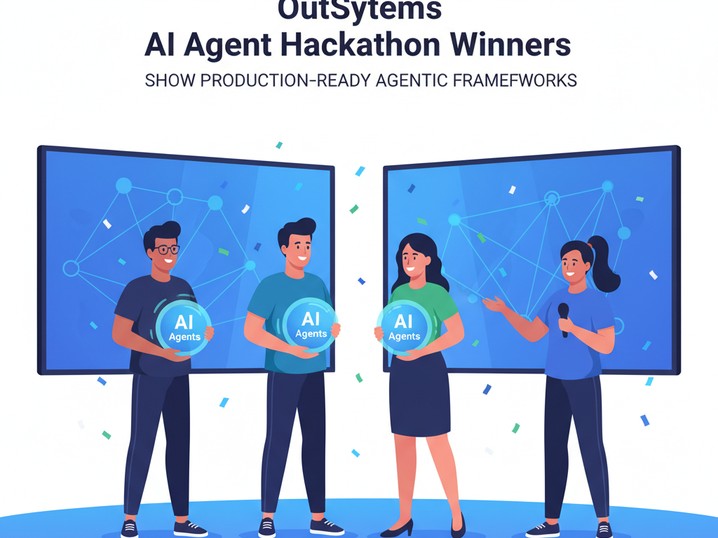

OutSystems AI Agent Hackathon Winners Show Production-Ready Agentic Frameworks
Small teams are moving AI agents from demos to live production—without hiring AI specialists or waiting months for engineering consensus. The OutSystems 2025 Hackathon and Innovation Awards prove that agentic automation is no longer academic.[1][2]
Executive Summary
- **Agentic frameworks solve the talent bottleneck**: 84 teams across 22 countries deployed working agents in weeks using low-code tools, proving you don't need ML engineers to ship production agents.[2]
- **Real operators are cutting processing time 50–90%** on high-leverage workflows—audit trails, customer support, internal research—with measurable ROI in under six months.[1]
- **The production test is passing**: Petrobras scaled agents across 100+ teams; Roche's employee AI companion reached 80,000 users in a year.[1] This isn't pilot theater anymore.
---
The Gap Most Teams Are Still Stuck In
We've heard this conversation dozens of times: "We want to automate [insert workflow], but we'd need to hire a data scientist. We don't have the budget. So we wait."
That framing was never quite right. But now it's obsolete.
For the past two years, the bottleneck wasn't whether agents could work—it was whether *normal product and operations teams* could deploy them without becoming AI infrastructure shops. Low-code agentic frameworks like OutSystems' Agent Workbench are closing that gap at production scale.
The 2025 hackathon results aren't academic exercises or proof-of-concept theater. They're examples of small, under-resourced teams shipping agents that run real workflows today. Some are already scaling across hundreds of users and teams.
---
Three Patterns From Winners That Actually Matter
1. Agents Excel at High-Leverage Repetitive Work
**Petrobras' audit AI agent cut research time by up to 90%.**[1] That's not incremental—that's a fundamental shift in what your people can accomplish.
Here's what made it work: The company identified a specific, high-volume task (audit trails require tracing through massive datasets). They built an agent to handle the pattern-matching and initial synthesis. Humans reviewed and signed off. Done.
The agent didn't replace auditors. It freed them to focus on judgment and risk. That's the production reality for agents in operational workflows.
Clarins applied the same logic to back-office operations: streamlined ERP, HR, and finance systems, saving $140,000 on a single application while cutting development time by 60%.[1] Not theoretical—financial benefit verified.
2. Fast Deployment Compounds Advantage
**Abu Dhabi Social Support Authority built and launched a financial support application in four months against a tight government deadline.** They then added two additional services 10 times faster than traditional build cycles—and achieved 95% customer satisfaction.[1][2]
A four-person team. No specialized AI engineers. Low-code platform. Four months to live.
The agency didn't stop at launch. Because agents reduced time-to-next-feature, they iterated aggressively. That velocity compounds. Services shipped faster. Adoption stayed high because feedback loops were tight.
For operators, this is the real ROI signal: fast first deployment unlocks faster secondary deployments.
3. Social Good and Internal Ops Use Similar Patterns
The hackathon had three winners building agents for accessibility and education:[2]
- **Persistent Ecovision** (1st place): Smart waste management with agent systems covering collection through recycling.
- **VoluntAI** (2nd place): Volunteer coordination for a nonprofit supporting parents of children with cancer.
- **NovioQ DAIKnow** (3rd place): Teacher app generating learning sessions, assessments, and performance tracking.
These weren't internal tools for a Fortune 500. They were built by small teams in weeks using the same Agent Workbench. The tooling democratized deployment. Scope didn't require 50-person engineering teams.
That matters because it means the frameworks work across use cases: business process automation, customer support, internal ops, and public service delivery all use the same underlying pattern.
---
The Production Proof Points
| Organization | Use Case | Metric | Timeline | |---|---|---|---| | **Petrobras** | Audit AI agent | 90% research time reduction | Scaled to 100+ teams | | **Roche** | Employee companion AI | 80,000 users | 1 year deployment | | **Roche** | AI assistant builder | 5,000 active users | 6 months deployment | | **Tokyo Electron** | ERP modernization + agents | 6 months → 2 weeks build time | 100+ new apps | | **SeAH Group** | Manufacturing MES modernization | 3x developer productivity; 90% fewer bugs; 70% faster features | Weeks | | **Clarins** | Back-office automation | $140K saved (single app); 60% faster delivery | 10 apps across 15 countries |
---
Why This Matters More Than Previous "AI Wins"
For two years, we've seen AI automation headlines that looked good in press releases but didn't translate to operators' workflows. Chatbots that needed constant tuning. ML models that required dedicated teams. Pilots that never became production.
The OutSystems winners avoid those traps because the framework shifts ownership.
**Traditional model:**
- Data science team builds the model in isolation.
- Product team tries to integrate it.
- Support finds edge cases the model doesn't handle.
- Build time: 6+ months.
- Risk of abandonment: High.
**Agentic low-code model:**
- Operators and product teams define the workflow and guardrails.
- Agent Workbench handles the orchestration and decision-making.
- Humans stay in the loop for exceptions and sign-off.
- Build time: weeks.
- Adoption: High because the team built it.
Petrobras proved this at scale: a low-code Center of Excellence supporting 100+ agile teams, with agents delivering 60% faster development and ROI at 15x within a year.[1]
---
The Honest Assessment: When Agentic Low-Code Works (and When It Doesn't)
We see teams reach for agents and fail when they skip this step: **Is the workflow repeatable and rule-based, or does it require human judgment on every decision?**
**Agents thrive when:**
- The workflow has clear inputs and decision logic (customer inquiry routing, audit trail generation, supply chain alerts).
- 70%+ of decisions follow predictable patterns; exceptions go to humans.
- Humans review or sign off on agent output (not a fully autonomous black box).
- The alternative is manual, high-volume, repetitive work.
- You can instrument it (measure cycle time before and after).
**Skip agents when:**
- The workflow is one-off or creative (novel strategy, high-stakes negotiation).
- Outcomes require deep domain expertise or judgment that's hard to codify.
- Your team can't afford the integration time or doesn't have buy-in.
- You're trying to replace people instead of augment them.
Tokyo Electron and SeAH Group succeeded because they applied agents to high-repetition manufacturing and operations workflows, not to strategic decision-making.
---
How to Evaluate an Agentic Framework for Your Team
Here's a framework we use with operators evaluating whether to pilot an agentic platform:
**1. Identify Your High-Leverage Workflow**
- Pick one task that eats 5+ hours per week across the team.
- It should be repetitive and rule-based (invoice processing, lead qualification, ticket routing).
- Estimate the cost if you paid someone to do it all year.
**2. Map the Decision Tree**
- Can you write down the logic in a flowchart?
- Are there exceptions? (Yes is fine—agents handle exceptions by escalating to humans.)
- How often does the logic change?
**3. Run a Two-Week Pilot**
- Use a low-code framework's trial or free tier.
- Build the agent with your team, not contractors (they'll learn the tool and keep ownership).
- Measure: cycle time before and after, user adoption, exception rate, accuracy.
**4. Calculate Break-Even**
- *Time saved per month* (hours) × *hourly cost* = *monthly benefit*.
- *Platform cost* (usually $200–500/month for small teams) ÷ *monthly benefit* = *break-even in months*.
- Most winning pilots hit break-even in 1–3 months.
**5. Decide: Pilot, Scale, or Skip**
- **Pilot status**: Accuracy >85%, adoption from team, break-even <3 months → Scale.
- **Uncertain**: Run another sprint with user feedback → Decide.
- **Skip**: Workflow too fuzzy, accuracy <70%, team doesn't trust output → Move to next workflow.
---
The Operator Verdict
Agentic AI isn't a maybe anymore. It's production-grade.
The hackathon winners proved that small teams—without AI specialists, without enterprise budgets—can deploy agents that handle real work at real scale. Petrobras, Roche, Tokyo Electron, and Abu Dhabi SSA didn't wait for perfect. They shipped, iterated, and scaled.
For you, that means:
- **Agents solve the talent gap**: You don't need to hire a data scientist to automate a high-leverage workflow.
- **Production is the baseline**: Pilots that reach 85%+ accuracy and user adoption should scale; the question is speed, not feasibility.
- **The ROI is traceable**: Measure cycle time, error rate, and people hours freed. If you can't measure it, it's not a real deployment.
- **Start with one workflow**: Pick the messiest, most repetitive task your team owns. Build, measure, scale.
The path from "this would be nice to automate" to "running in production across teams" now takes weeks, not years. The teams that realized that first are already shipping.
---
Next Steps
**This week:**
- Identify one high-repetition workflow your team owns that eats 5+ hours weekly.
- Document the decision logic (what does a person check at each step?).
- Map the volume (how many instances per month).
**Next week:**
- Request a trial of a low-code agentic framework (OutSystems, Mendix, or comparable tools offer 30-day free trials).
- Build a minimal agent for step 1 of your workflow.
- Get feedback from the team that will use it.
**Break-even math:**
- If your team saves 10 hours per week at $50/hour, that's $500/month in value.
- A platform at $300/month breaks even in less than three weeks.
Small operators who move now—identifying one production-ready agent workflow before Q2 2026—will have captured the velocity edge over competitors still stuck in pilot phase.
---
**Meta Description:** Small teams are shipping production AI agents without hiring specialists. Here's how the OutSystems hackathon winners proved agentic low-code works—and how to evaluate it for your workflows.