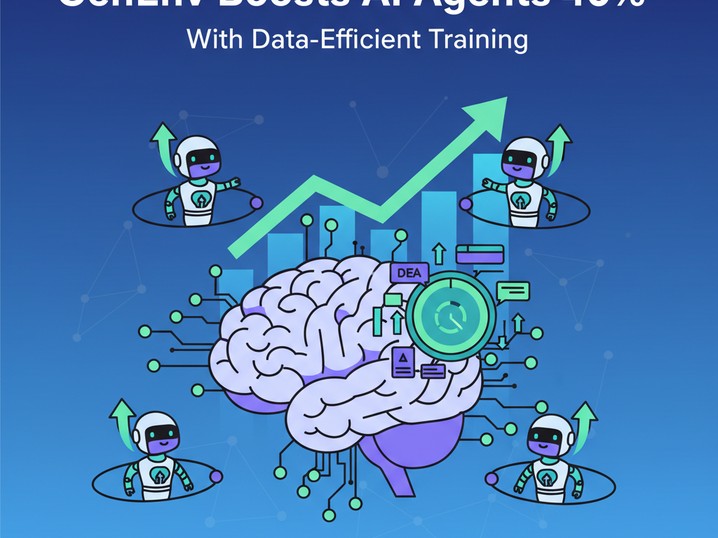

GenEnv Boosts AI Agents 40% With Data-Efficient Training: What Lean Teams Need to Know
**Executive Summary**
- GenEnv, a dynamic training framework, improves AI agent performance by over 40% while cutting data requirements by 3.3x compared to larger models[1]
- Instead of training agents on static datasets, GenEnv creates a co-evolutionary curriculum that gradually raises task difficulty as the agent learns—mimicking how humans improve[1]
- For small teams building custom AI agents, this means competitive performance without the massive data collection and annotation costs that typically favor well-funded competitors[1]
---
The Problem We're All Facing: AI Agents Are Expensive to Train
We've watched this play out across every slack channel and funding pitch: building AI agents that work requires mountains of training data.
That's the bottleneck nobody talks about in the hype cycle. You need hundreds of examples. You need clean, annotated examples. You need engineers babysitting the process. And you need all of it *before* your agent is competent enough to generate real business value.
For founders and small teams, that math doesn't work. Enterprise competitors can justify months of data collection and six-figure training budgets. You can't.
So we're left squinting at open-source models, renting API access to Gemini or Claude, or both—trying to punch above our weight class without the data infrastructure that scales.
A research team at universities including Tsinghua has introduced something that changes this equation: GenEnv, a framework that trains AI agents more efficiently than anything available today[1].
And for once, the headline isn't hype.
---
What GenEnv Actually Does (Without the Jargon)
Most AI agent training works like this: you build a dataset, you train the agent on it, it reaches a plateau, you collect more data, and you start over.
GenEnv flips that model. Instead of feeding static examples to your agent, it creates a **dynamic environment simulator that evolves alongside the agent**[1].
Here's the practical metaphor: imagine coaching a tennis player. A good coach doesn't throw the same serve at the same speed forever. They watch what the player can handle, gradually make serves harder, and adjust based on whether the player is improving or getting frustrated. That's GenEnv.
The system works by:
- **Starting simple:** The environment simulator creates easy tasks matched to the agent's current skill level[1]
- **Tracking progress:** A "Curriculum Reward" system monitors whether the agent is succeeding at the right rate—not too easy, not impossible[1]
- **Raising difficulty dynamically:** As the agent improves, the simulator automatically increases task complexity[1]
- **Measuring growth:** Researchers observed agent reasoning chains grow from 137 tokens to 204 tokens across six training epochs—a measurable improvement in problem-solving depth[1]
The agent learns faster because it's always operating at the edge of its capability. No wasted cycles on tasks it already mastered. No wall of impossible examples it can't parse.
---
The 40% Performance Boost: What It Actually Means
The research team tested GenEnv across five real-world benchmarks: API-Bank, ALFWorld, BFCL, Bamboogle, and TravelPlanner[1]. These aren't lab toys. They simulate actual agent tasks—calling APIs, navigating software interfaces, planning multi-step workflows.
The result: **GenEnv improved agent performance by over 40% compared to existing methods**[1].
But let's translate that into operator language.
A 40% performance jump means an agent that failed 3 out of 10 tasks now succeeds at 8 out of 10. That's the difference between a tool your team uses and a tool that sits unused because it fails at critical moments.
More important: GenEnv achieved this while using **significantly less data than larger systems**[1]. The team ran competitive benchmarks against much larger models (like Gemini 2.5 Pro) while using 3.3x less training data.
For your budget, that's everything.
---
Why Data Efficiency Matters for Your Team
Here's a number that rarely makes it into product announcements: labeling training data costs $10–$25 per example for complex tasks.
If you need 1,000 examples to train a custom agent—handling your specific API integrations, your CRM quirks, your internal workflows—you're looking at $10,000–$25,000 just in annotation.
That's before hiring someone to collect, clean, and validate the data.
GenEnv collapses that cost because the simulator generates synthetic tasks dynamically. Your team doesn't need to pre-build a massive dataset. The system creates learning material in real time, calibrated to the agent's needs[1].
For founders running lean operations, that's a fundamental unlocking of possibility. You can build agents that compete with bigger companies' capabilities without their budgets.
---
Real Scenario: When GenEnv Changes Your Math
**Sarah runs lead qualification for a 25-person SaaS company.** She needs an AI agent that can pull info from LinkedIn, cross-reference it against her CRM, and score leads on custom criteria her sales team defined.
**The traditional path:**
- Hire a contractor or use an ML service: $8,000–$15,000 to collect and label 500 examples
- Train a model: 2–4 weeks
- Iterate on failures: another $3,000–$5,000
- Total time-to-competence: 8–12 weeks
**With GenEnv:**
- Provide 20 seed examples of good and bad leads
- Let the simulator generate synthetic variations based on her CRM schema
- The curriculum reward system trains the agent while raising difficulty automatically
- Target: 4–6 weeks, significantly lower annotation cost
Sarah doesn't get a perfect agent immediately. She gets one that works well enough for her team to use, validate feedback, and improve. That's where the actual ROI compounds.
---
The Honest Limitations (When to Skip This)
GenEnv isn't a silver bullet. We need to be clear about the boundaries.
**When GenEnv is overkill:**
- You're building a generic chatbot or customer service agent (existing fine-tuned models already solve this at lower cost)
- Your task doesn't involve sequential decision-making or tool use (simpler supervised learning approaches work fine)
- You have abundant, high-quality labeled data already (the efficiency gain doesn't move the needle)
**Where implementation gets messy:**
- You need to define a reward function for your specific task—that still requires domain expertise
- The environment simulator needs to capture the essential complexity of your real task, or training generalizes poorly
- Integration with your existing stack (Zapier, Make, LangChain) requires engineering time upfront
GenEnv is powerful *for teams building custom agents that interact with your specific tools and workflows*. If you're using off-the-shelf AI products, it doesn't affect you directly—yet.
---
The Operator's Decision Framework
**Verdict: Pilot for custom agent projects**
Ask yourself:
- **Do we need a custom agent?** (Not a chatbot or recommendation engine—something that automates multi-step workflows specific to our business.) ✓ Yes → Move to 2 / ✗ No → Use off-the-shelf models
- **Do we have at least 10–20 examples of the task working?** (Not 500—just enough to seed the simulator.) ✓ Yes → Move to 3 / ✗ No → Collect examples first
- **Can we define a success metric for our agent?** (E.g., "lead score is within 10% of human judgment.") ✓ Yes → Pilot / ✗ No → Clarify scope first
**If all three are true:** GenEnv reduces your data collection burden by 60–70% and cuts training timeline in half. The ROI justifies a 6–8 week pilot.
---
What's Actually Happening Here
GenEnv represents a shift in how AI capabilities scale. For years, the assumption was: *more data = better models = competitive advantage*. Bigger companies won because they had bigger datasets.
GenEnv introduces a new variable: *better curriculum design = faster learning = smaller data needs*.
That's why we're calling it out. It levels the playing field.
We can't all afford to collect 100,000 labeled examples. But we *can* afford to run a dynamic simulator that teaches an agent on-demand.
---
Next Steps: What We'd Do This Week
If custom agents are on your roadmap:
- **Map your highest-friction workflow** that would benefit from automation (choose one—don't boil the ocean)
- **Collect 15–20 examples** of that task working end-to-end
- **Sketch your reward function** (What does "success" look like? Can you measure it?)
- **Pilot with an open-source framework** that supports dynamic curricula (explore implementations emerging from this research)
- **Track iteration cycles and data cost** against your baseline
Don't wait for a polished product release. The research is fresh, and the gap between cutting-edge techniques and production tooling is where operators often find asymmetric advantage.
We've seen this pattern before with RAG, fine-tuning, and function calling. The teams that pilot early—not perfectly, just early—compound learnings that bigger competitors discover six months later.
---
Meta Description
GenEnv trains AI agents 40% better using 3.3x less data. Here's how lean teams use dynamic curricula to compete without massive training budgets.